
⚡ Key Takeaways
- 92% of college students use AI to study — but only 18% admit using it to complete work for them. Usage is universal; misuse is a minority.
- Formal AI-cheating incidents rose 4.7× in two academic years (1.6 → 7.5 per 1,000 students).
- An estimated 94% of AI-written assignments go undetected — detection has effectively lost.
- 54% of teens use AI chatbots for schoolwork; 10% use AI for most or all homework.
AI cheating statistics get quoted in every school-board meeting and university senate right now, usually without sources. This page collects the current survey and institutional data — student AI usage, actual misuse rates, detection failure rates, and discipline trends — each figure attributed, current as of July 2026. The headline finding is more nuanced than the panic: nearly every student uses AI, a modest minority uses it to cheat, and institutions catch almost none of it.
The headline numbers
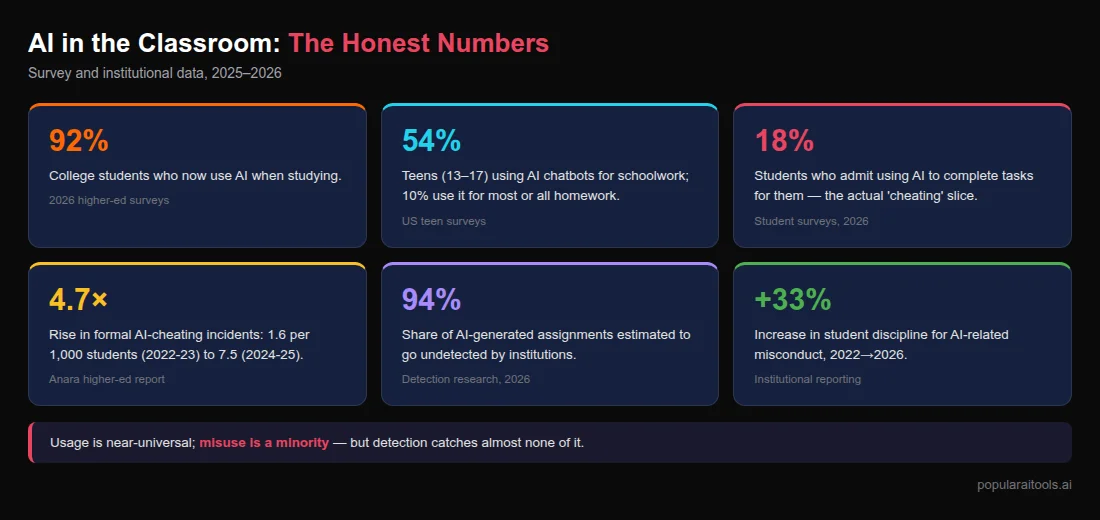
Start with the distinction most coverage flattens: using AI ≠ cheating with AI. In 2026, 92% of college students report using AI while studying — explanation, summarization, practice problems. The cheating slice — having AI complete tasks for them — is 18%. Big enough to matter, nowhere near "everyone cheats now." Among 13–17-year-olds, 54% use AI chatbots for schoolwork and roughly 1 in 10 uses AI for most or all homework.
What students actually do with it
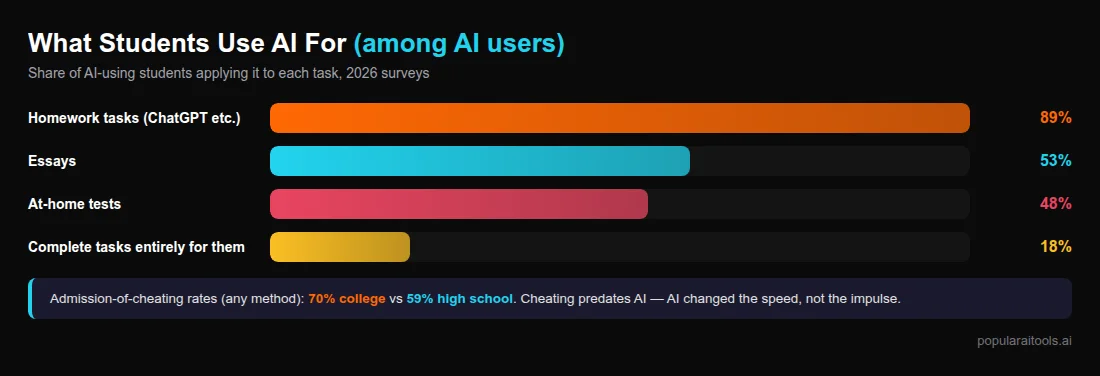
Among AI-using students, 89% use ChatGPT or similar chatbots for homework, 53% for essays, and 48% for at-home tests — that last number being the one that has effectively ended the take-home exam. Context that predates the technology: 70% of college students admit to some form of academic dishonesty (59% in high school). Cheating didn't start with ChatGPT; AI industrialized it. School type shows a striking spread too — 24.1% of charter students admitted unauthorized AI use versus 15.2% public and 6.4% private.
Detection has lost — for now
Formal AI-cheating incidents in higher education rose from 1.6 per 1,000 students in 2022-23 to 7.5 per 1,000 in 2024-25 — a 4.7× jump — and discipline for AI misconduct is up 33% since 2022. Yet detection research estimates ~94% of AI-generated assignments sail through undetected. Both things are true because the caught cases are the clumsy ones. AI text detectors are unreliable enough that false positives punish honest students — including non-native English speakers whose writing pattern-matches "AI-like" — which is why the serious institutional response is shifting from detection to assessment redesign: oral defenses, in-class writing, process portfolios.
The uncomfortable equilibrium of 2026: universal AI access, minority misuse, near-zero detection — and a growing consensus that the assignment, not the student, is what has to change.
Citing this pagePopularAiTools.ai, "AI Cheating Statistics 2026," last updated July 17, 2026 — https://popularaitools.ai/blog/ai-cheating-statistics. Figures compiled from 2025–2026 student surveys, the Anara higher-education report, and institutional disclosure data; each stat is attributed in context above.